
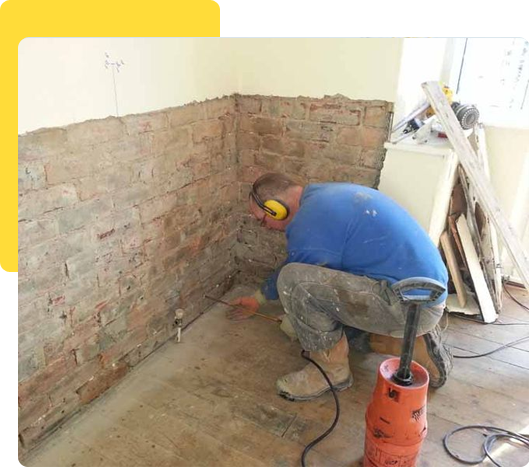
What is rising damp?
Rising damp is water from the ground which has been absorbed into walls by porous building materials such as brick or mortar. Moisture then travels upwards naturally by capillary to appear as rising damp internally which can cause damage to internal decorations, plaster as well as possible fungal decay in skirting boards and floorboards etc
What causes rising damp?
Building regulations have required all houses built since 1875 to have a damp-proof course (DPC) built into the walls. A DPC is a layer of water-resistant materials which block water from spreading upwards, originally made from a mix of hard stones such as slate or flint, while modern homes use layers of PVC plastic. A failed or – in very old buildings – missing DPC allows rising damp to spread up above floor level causing dampness in brickwork , plaster and skirting boards.
Building regulations have required all houses built since 1875 to have a damp-proof course (DPC) built into the walls. A DPC is a layer of water-resistant materials which block water from spreading upwards, originally made from a mix of hard stones such as slate or flint, while modern homes use layers of PVC plastic. A failed or – in very old buildings – missing DPC allows rising damp to spread up above floor level causing dampness in brickwork , plaster and skirting boards.
How to spot rising damp
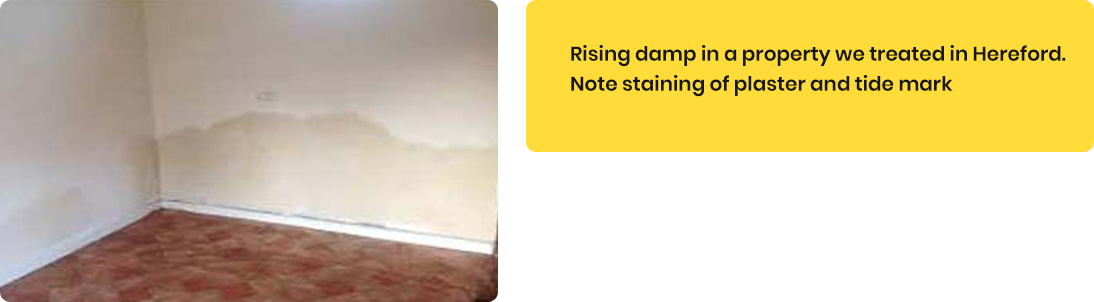
Like all forms of dampness, rising damp is often noted when plaster is stained and crumbing with a rising tide mark of damp up to around one metre on affected walls. Skirting boards fitted to damp walls will absorb moisture from brickwork and the high moisture contentcan lead to fungal decay and there may be signs of buckling or deformation of the skirting boards or other timbers fitted to a damp wall
The difference with rising damp is that the discolouration will start at the floor and have a clear stopping point where the water reached as far as it could. Often, this point has a white, powdery line along it formed by hygroscopic salts which are carried up from the ground and building materials, called a “tide mark”.
These hygroscopic salts often cause problems of their own being like common household salt they constantly absorb water from both the brickwork and air within a room, causing your walls to become damp not just from the ground but also from moisture in the air as well.
How to treat rising damp- 20 year guarantee
Rising damp is a problem that affects many older properties in Hereford that do not have an effective damp-proof course but at Hereford Damp and Mould Control we have several effective solutions for rising damp which will stop any further dampness and help your walls to dry out.


The most effective method offered by Hereford Damp & Mould Control for rising damp is the Freezteq Frozen Damp Course which is acknowledged as the most effective process of retro-fitting a chemical damp-proof course by the scientists and experts damp-proofing industry. This method is a diffusion process of using frozen damp-proof ice sticks and the Freezteq process and has been used successfully in thousands of properties since e it was invented in 1965 and was awarded a BBA certificate in 1992 by British Board of Agrément (Certificate 92/2849)
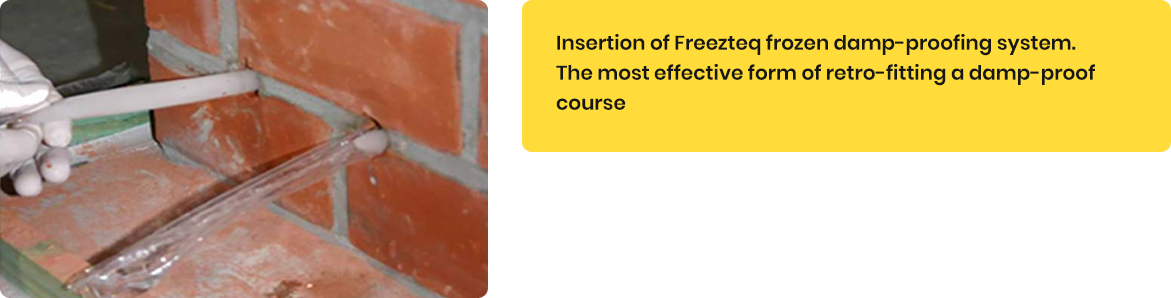
Freezteq frozen damp-proofing is the most effective form of retrofitting a chemical damp-proof course available today and its slow diffusion process ensures that a waterproof barrier is formed across the whole section of a treated wall. Frozen ice-sticks of Freezteq damp-proofing fluid are inserted into pre-drilled 22mm diameter holes.
The ice-sticks then melt gradually and the siliconate damp-proofing fluid transfuses into the capillaries of the masonry, lining the pores of the brickwork or stone with a hydrophobic layer which reverses capillary action and therefore prevents further rising dampness. After the initial ice-sticks have melted further frozen ice-sticks are inserted a further three to four times to ensure that a continuous damp-proof barrier is formed.The silicone material does not block the capillaries and therefore allow the masonry to breathe and the structure of the wall remains unchanged. The water repellent used in the transfusion process is non-toxic and completely inert once cured and has no deleterious effect on the masonry into which it has been introduced.
The Freezteq diffusion dpc is a much superior to an injected damp-proof course which is pumped into brickwork under pressure causing viscous fingering which instead of producing a continuous waterproof barrier forms fingers of waterproof bands and the best this process achieves is to stop only a fraction of the dampness rising up the wall
The slow melting of the Freezteq damp-proofing system ensures a continuous water repellent barrier throughout the treated area, because the system depends on natural seepage (diffusion), which research has shown to be the most effective method for fluid distribution in masonry, accurate dosages can be readily achieved and a complete band of water-proof masonry is formed across the complete cross section of a treated wall.When comparing Freezteq damp-proofing with the cream dpcs the amount of damp-proofing fluid introduced into the wall by Freezteq dpc diffusion is around 15 to 20 times greater than that of the cream dpcs. If 22mm holes are drilled to a depth of 175 mm in a 225mm wall and Freezteq frozen dpc ice-sticks inserted then one dose of dpc will provide nearly 5 times as much damp-proofing fluid as cream dpc hole of 10mm diameter and 175mm length .This is based on the volume of a cylinder being proportional to the square of the radius and length and with the length of both holes being the same then the difference in volume is in relation to the radius of the holes and 11 ( half the diameter ) squared is 121 with 5 squared being 25, therefore the actual volume of the Freezteq hole is 4.84 larger than the cream dpc hole. Once the initial Freezteq dpc stick has melted into the wall then a further two or three more doses are installed giving a much greater quantity of damp-proofing fluid than any cream dpc system could hope to achieve and therefore providing a much superior damp-proofing system.
FREEZTEQ DAMP-PROOFING COMES WITH A TWENTY-YEAR GUARANTEE- ACCEPTED BY ALL BANKS AND BUILDING SOCIETIES FOR MORTGAGES ETC.
Pre-purchase surveys carried out for damp and timber decay related problems which may have been detected on you mortgage survey
If you feel that your property is affected by rising dampness then please feel free to call us on 01432 629020 for free, impartial advice. Free damp surveys and estimates for homeowners.
AtHereford Damp & Mould Control we are happy to discuss any damp related problems that may be having an adverse affect on your house and offer over the phone advice or arrange an inspection if required. Initial inspections are also free and we will offer you the most cost effective and beneficial advice and solutions to your rising dampness problems.
All damp-proofing works come with a twenty year guarantee
Alternatively contact us through the form on the Contact Us page to request a free survey or to learn more information about our services.

